
The EU Instant Payments Regulation (IPR), formally Regulation (EU) 2024/886, entered into force on 8 April 2024. For the banks that process the majority of euro credit transfers in the Single Euro Payments Area, the compliance deadlines fell in 2025. For electronic money institutions (EMIs) and payment institutions (PIs), the critical deadlines are in 2027, and the infrastructure changes required to meet them are architectural, not procedural.
The instant payments regulation does not ask EMIs and PSPs to add a faster processing option. It mandates that every institution offering euro credit transfers must also offer instant credit transfers, at no additional cost to the client, executed within ten seconds, around the clock, every day of the year. That requirement, applied to an institution whose core platform was built around batch processing, overnight settlement windows, and business-hours compliance operations, demands a fundamental rethink of how payment execution, sanctions screening, liquidity management, and reconciliation actually work.
Many EMIs and PSPs are likely to struggle with the 2027 implementation deadlines for SEPA instant payments. The primary reason is not a lack of awareness of the SEPA instant payments requirements but an underestimation of how much of the existing payment infrastructure needs to change before real-time settlement becomes operationally viable. This article examines what the instant payments regulation requires, why the infrastructure challenge is deeper than most compliance timelines acknowledge, and what EMIs and PSPs need to address in their core platform before the deadlines arrive.
Part One: What the EU Instant Payments Regulation Actually Requires
What are the five core obligations under the instant payments regulation?
The Instant Payments Regulation amends the SEPA Regulation, PSD2, and the Settlement Finality Directive. It introduces five obligations that apply to all PSPs offering euro credit transfers in the SEPA area.
Universal instant payment availability
Any PSP that offers the service of sending or receiving standard SEPA credit transfers must also offer instant credit transfers in euros. The obligation applies to all payment initiation channels through which the PSP currently offers standard credit transfers, whether mobile, online, or otherwise. A PSP cannot offer instant payments on some channels but not others.
10-second execution, 24/7/365
Instant credit transfers must be executed at any time of day, on any calendar day, including weekends and public holidays, with funds made available to the beneficiary within ten seconds of the payment order being submitted. There is no provision for reduced availability windows or scheduled maintenance that would interrupt the obligation to process payments.
No premium pricing
Under Article 5b of the amended SEPA Regulation, charges for instant credit transfers may not exceed the charges applied to standard credit transfers of the equivalent type. PSPs may not impose a surcharge for the real-time execution capability.
Verification of Payee (VoP)
Before executing an instant credit transfer, PSPs must verify that the name of the beneficiary provided by the payer matches the name associated with the IBAN in the beneficiary’s PSP’s records. This check must be performed in real time, the result communicated to the payer, and the service provided free of charge. VoP applies to credit transfers of all types, not only instant, from October 2025 onward.
Daily sanctions screening
Because transaction-by-transaction sanctions screening within a ten-second window is operationally impractical, the instant payments regulation replaces it with a requirement for comprehensive daily screening of the PSP’s full client base against EU restrictive measures lists. This shifts the compliance burden from the transaction level to the client level, but demands that daily screening is complete, automated, and capable of flagging new sanctions designations in real time.
What are the specific deadlines that apply to EMIs and payment institutions?
The instant payments regulation applies its deadlines in waves, prioritising eurozone banks before extending obligations to non-bank PSPs. The deadlines, past and future, that directly govern EMIs and PIs are as follows:
9 October 2025: Verification of Payee applies to all PSPs, including EMIs and PIs, across the SEPA area. This deadline has already passed. Any EMI that offers standard euro credit transfers and has not yet implemented a VoP response mechanism is already non-compliant, unless they fall under exceptions.
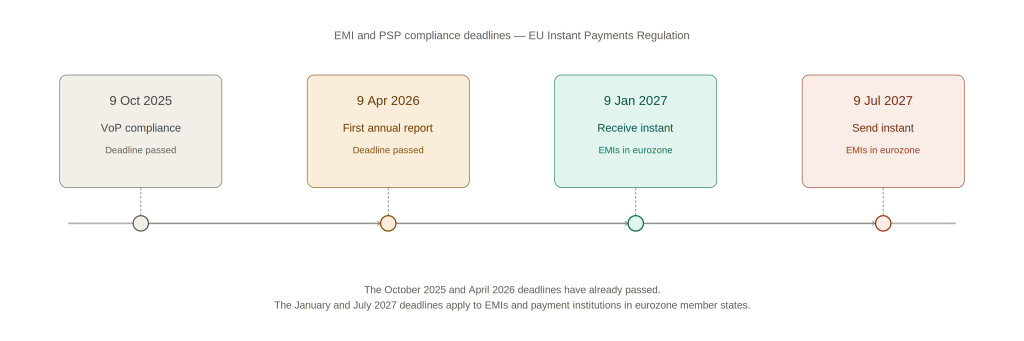
9 April 2026: All PSPs, including EMIs, must submit their first annual regulatory report to their national competent authority (NCA) covering charges for credit and instant transfers, payment volumes, and the share of transactions rejected due to EU restrictive measures. The EBA’s Implementing Technical Standards (EBA/ITS/2025/02) define the mandatory templates and XBRL taxonomy for these reports.
9 January 2027: EMIs and PIs in eurozone member states must be able to receive instant euro credit transfers. Infrastructure that can only accept payments during business hours, or that processes incoming credits in batched end-of-day runs, will not meet this requirement.
9 July 2027: EMIs and PIs in eurozone member states must be able to send instant euro credit transfers. This is the deadline most likely to be missed, because sending instant payments requires not just connectivity to an instant settlement mechanism but full integration between the payment initiation flow, the real-time compliance layer, the liquidity position, and the outbound messaging infrastructure.
Why does the instant payments regulation change more than payment speed?
The framing of the instant payments regulation as a speed requirement is technically accurate but operationally misleading. An EMI that simply connects to TARGET Instant Payment Settlement (TIPS) and routes outbound payments to the instant rail has not met the regulation. It has added a new payment channel. The obligations that follow from that addition, such as perpetual availability, real-time VoP, daily sanctions screening, liquidity continuity, and annual regulatory reporting, require changes to every functional layer of a payment platform, not just the outbound connectivity module.
For an EMI accustomed to a payment operating model anchored in business hours, end-of-day settlement, and overnight compliance batch runs, the instant payments regulation is effectively a mandate to redesign the operating model. The compliance function must operate 24/7. The liquidity management function must maintain pre-funded positions at all hours. The reconciliation function must close positions in real time rather than at the end of the day. Each of these changes has direct implications for what a core banking platform must be able to do.
Part Two: The Infrastructure Challenge the Compliance Timeline Does Not Capture
Why does real-time execution break batch-oriented core platforms?
Many core banking platforms used by EMIs today were designed around a transactional model in which payment orders are accepted, queued, processed in sequence, and settled in batches at defined intervals. The intraday processing cycle may be fast, but it is fundamentally sequential and bounded: payments are processed in order, compliance checks run against a batch, and settlement positions are reconciled against end-of-day totals from the correspondent.
Real-time instant payment execution requires a fundamentally different architecture. Every payment must be processed independently and immediately, triggering a compliance check, a balance verification, an outbound message to the settlement infrastructure, and a ledger posting, all within the ten-second window and concurrently with every other payment being processed at the same moment. Under the EU Instant Payments Regulation, there is no provision for queuing payments during a high-volume period or deferring processing to a lower-demand window.
For platforms built on event-driven, cloud-native architecture, this concurrency requirement is a design feature they already support. For platforms built on synchronous processing pipelines with sequential database writes, it is a structural incompatibility that cannot be resolved by configuration or a minor upgrade. The 10x Banking 2026 Trends Report identifies this as the defining infrastructure divide in European banking this year: institutions moving from third-generation, vendor-locked cores to fourth-generation, cloud-native platforms designed for event-driven, real-time processing, and those still attempting to retrofit real-time capability onto sequential architectures.
What does Verification of Payee require from your infrastructure?
Verification of Payee is frequently treated as a data integration task: retrieve the beneficiary name from the counterpart PSP’s directory and return a match, close match, or no-match result. In practice, VoP requires four distinct infrastructure capabilities that many EMIs have not yet built out.
First, the EMI must be able to respond to VoP queries from other PSPs, checking the names of payees held in the EMI’s own account registry. This requires an always-on VoP endpoint that can receive a name and IBAN query and return a validated response, drawing on the EMI’s internal account data, within the time constraints imposed by the querying PSP’s own ten-second execution window.
Second, the EMI must be able to submit VoP queries to the payee’s PSP before executing a payment, retrieve the response, present it to the payer, and record the payer’s decision to proceed. This must happen within the ten-second window, which means the VoP lookup, the user interface interaction, and the payment execution are all constrained within the same time budget.
Third, the EMI must maintain a clean and current account registry that accurately reflects the legal name associated with each account. Discrepancies between the name on the payment order and the name in the registry will generate close-match or no-match responses, resulting in payment friction for clients and potential liability for the EMI if a fraudulent payment is later disputed.
Fourth, the EMI must maintain an audit trail of every VoP query and response, the payer’s decision when a discrepancy was flagged, and the subsequent payment outcome. Under Article 5c of Regulation (EU) 2024/886 and the EPC Verification of Payee Rulebook, institutions must be able to demonstrate compliance with the VoP obligation in regulatory reviews, which means the audit trail must be complete, timestamped, and accessible.
How does the 10-second window change your compliance architecture?
The ten-second execution window is simultaneously an operational requirement and a compliance constraint. Under the SEPA instant payments framework, a PSP cannot delay an instant payment to complete additional compliance checks that its standard payment flow would have allowed. The compliance checks must either be completed within the ten-second window or must have been completed in advance.
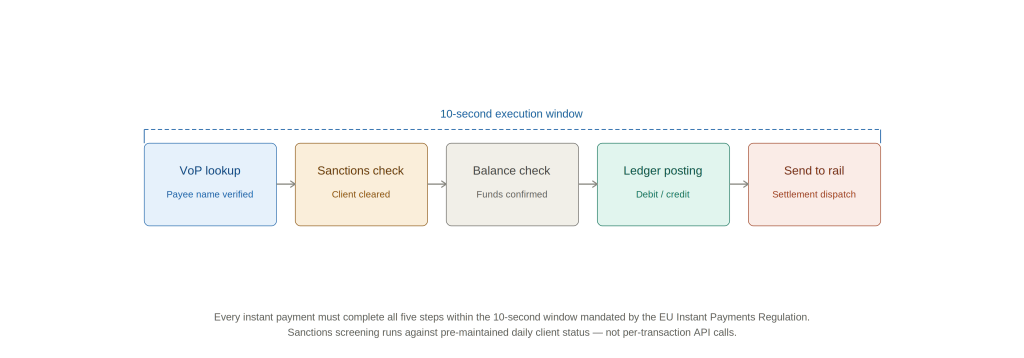
The instant payments regulation resolves this for sanctions screening through the daily screening model: by maintaining a continuously updated screening status for every client in the registry, a PSP can confirm at the point of payment execution that both the payer and the beneficiary have been screened against current EU restrictive measures without performing a transaction-level API call. This requires that the daily screening run is genuinely comprehensive, that new designations are incorporated immediately when published, and that the screening status of every client is queryable by the payment execution engine in real time.
For transaction monitoring and AML obligations, the AMLA, which assumed direct supervisory powers over high-risk institutions in July 2025, has been explicit that the speed of payment execution does not reduce AML/CTF expectations. Transaction monitoring rules must apply to instant payments in the same way they apply to standard credit transfers. The practical implication is that the transaction monitoring engine must be capable of evaluating a payment against its configured rule set within the ten-second window, which rules out any architecture in which monitoring rules are evaluated in a post-settlement batch run.
Part Three: Liquidity, Reporting, and the Operational Reality of 24/7 Settlement
What does round-the-clock instant settlement mean for liquidity management?
Under standard SEPA credit transfer processing, an EMI can manage its liquidity position across a defined settlement cycle. Outbound payments are funded from a correspondent account, inbound settlements replenish that account at defined intervals, and the treasury function manages intraday and end-of-day positions within predictable windows. The settlement infrastructure, whether TIPS or a national instant payment system, settles continuously and in real time, including, for example, at 3 AM on a Sunday.
For instant payments under the instant payments regulation, the outbound settlement position must be funded at all times. An EMI that runs out of pre-funded capacity in its TIPS account at any point, on any day, cannot execute outbound instant payments until the position is replenished. There is no overnight settlement window that resets the position. Treasury operations must either maintain a permanently sufficient pre-funded balance, which has a capital cost, or implement automated intraday liquidity management that can detect a low position and replenish it before the shortfall affects payment execution.
The European Central Bank’s guidance on TIPS participation and the access rules for EMIs under the amended Settlement Finality Directive establish the framework within which EMIs can hold positions directly in the central bank settlement infrastructure. For EMIs that access instant settlement through a sponsoring bank rather than directly, the liquidity position is held at the sponsor, which introduces a dependency on the sponsor’s own liquidity management and the terms of the access arrangement.
What are the new regulatory reporting obligations under the IPR?
From April 2026, all PSPs in scope of the instant payments regulation are required to submit annual reports to their national competent authority covering charges applied to credit and instant credit transfers, volumes of instant and non-instant payments by channel, and the share of payment transactions rejected due to the application of EU targeted financial restrictive measures.
The EBA’s Implementing Technical Standards (EBA/ITS/2025/02) define mandatory reporting templates, an XBRL taxonomy, and validation rules that govern the format and content of submissions. These are not discretionary. An EMI whose data architecture cannot disaggregate payment volumes by type, channel, and rejection reason, and export them in the prescribed XBRL format, will not be able to produce a compliant annual report.
The first reporting period covers the retrospective window from April 2025 to April 2026. The report was due on 9 April 2026. For EMIs that have not yet mapped their payment data architecture to the EBA’s reporting requirements, establishing that mapping retroactively for the first report and prospectively for subsequent years requires exactly the kind of granular transactional logging that legacy core platforms often do not maintain natively.
What happens to EMIs that miss the deadline?
The instant payments regulation carries enforcement consequences that sit within the existing supervisory framework of each member state’s NCA, with the European Banking Authority exercising oversight of consistent application across the EU.
Missing the January 2027 receiving deadline or the July 2027 sending deadline not only creates regulatory exposure. It creates a competitive disadvantage that compounds over time. Clients that require instant payment functionality, whether for payroll, treasury operations, marketplace settlements, or embedded finance products, will route those payment flows to PSPs that can support them. An EMI that is technically non-compliant with the SEPA instant payments mandate loses those clients to compliant competitors and does so in a market where the ability to support instant payments is increasingly a baseline commercial expectation rather than a premium capability.
Instant Payments Readiness Built Into the Core
The infrastructure requirements described in this article, event-driven processing, real-time compliance evaluation, continuous sanctions screening, 24/7 liquidity monitoring, VoP endpoint availability, and granular regulatory reporting, are not capabilities that can be retrofitted onto a batch-oriented core platform without substantial re-architecture. They are platform design decisions that determine whether an EMI or PSP can meet the instant payments regulation deadlines at all, and whether it can do so without accumulating operational debt that surfaces as exceptions, reporting failures, and compliance gaps as volumes scale.
Baseella’s core platform is built on an event-driven architecture in which every payment instruction triggers an immediate, in-process evaluation chain: balance verification against the live account position, real-time risk scoring through the internal Scoring module, sanctions status check against the Block lists module’s continuously updated local copy of EU restrictive measures, and outbound routing through the payment orchestration layer. There is no batch queue between payment initiation and execution. Every step happens in-process, drawing on internal state, within the execution window required by the EU Instant Payments Regulation.
Verification of Payee is supported natively, with Baseella’s account registry serving as the data source for inbound VoP queries from counterpart PSPs and the VoP lookup integrated directly into the outbound payment initiation flow. Liquidity monitoring runs continuously against the settlement position, with configurable alert thresholds and automated escalation workflows. Regulatory reporting under the EBA’s ITS/2025/02 requirements is supported through Baseella’s reporting module, which maintains the granular transactional logs required to disaggregate volumes by payment type, channel, and rejection reason in the prescribed format.
For EMIs and PSPs evaluating their readiness for the 2027 deadlines, the diagnostic questions are straightforward: can your platform process a payment instruction, complete a VoP lookup, evaluate it against your sanctions screening status and transaction monitoring rules, post a ledger entry, and dispatch an outbound settlement message — all within ten seconds, at any hour, without a batch processing dependency? If any step in that chain relies on a scheduled process, an overnight run, or a sequential queue, it requires architectural attention before the January 2027 deadline arrives.
To see how Baseella supports instant payment readiness, Verification of Payee, real-time compliance, and regulatory reporting under the EU Instant Payments Regulation, we invite you to visit Baseella online or schedule a demo.